


What you should know about this indicator
- Gross domestic product (GDP) is a measure of the total value added from the production of goods and services in a country or region each year. GDP per capita is GDP divided by population.
- This indicator provides information on economic growth and income levels in the medium run. Some country estimates are available as far back as 1950.
- This data is adjusted for inflation and differences in living costs between countries.
- This data is expressed in international-$ at 2021 prices, using a multiple benchmark approach that incorporates PPP estimates from all available benchmark years.
- For GDP per capita estimates in the very long run, see the Maddison Project Database's indicator.
- For more regularly updated estimates of GDP per capita since 1990, see the World Bank's indicator.
Related research and writing
Explore charts that include this data
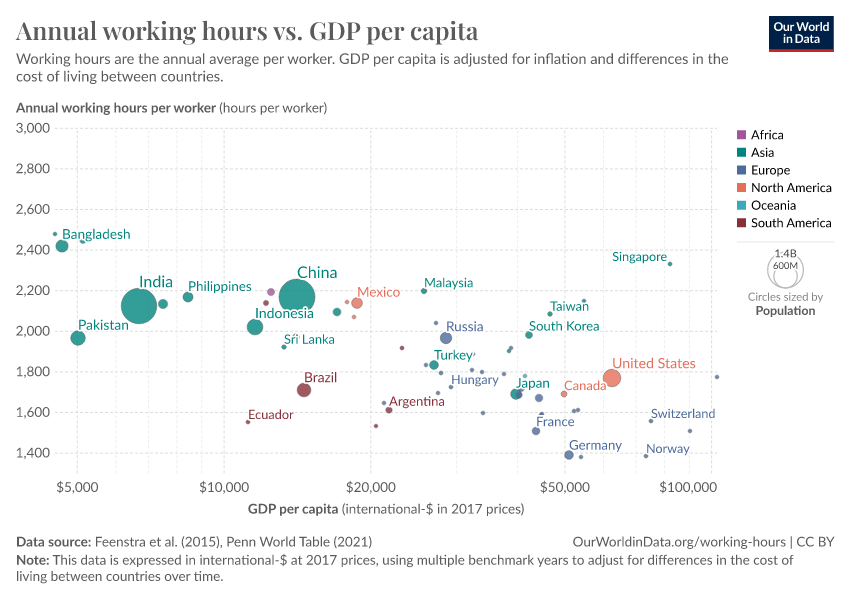
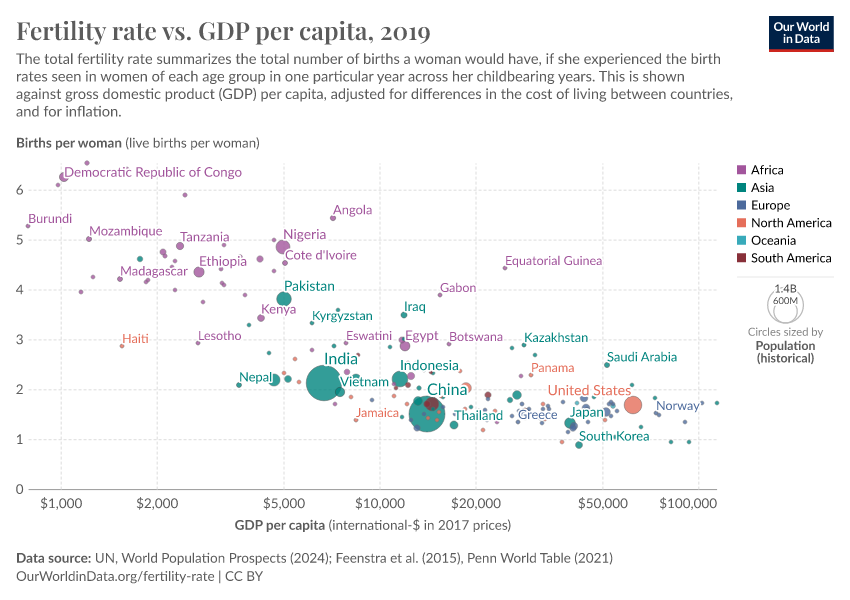
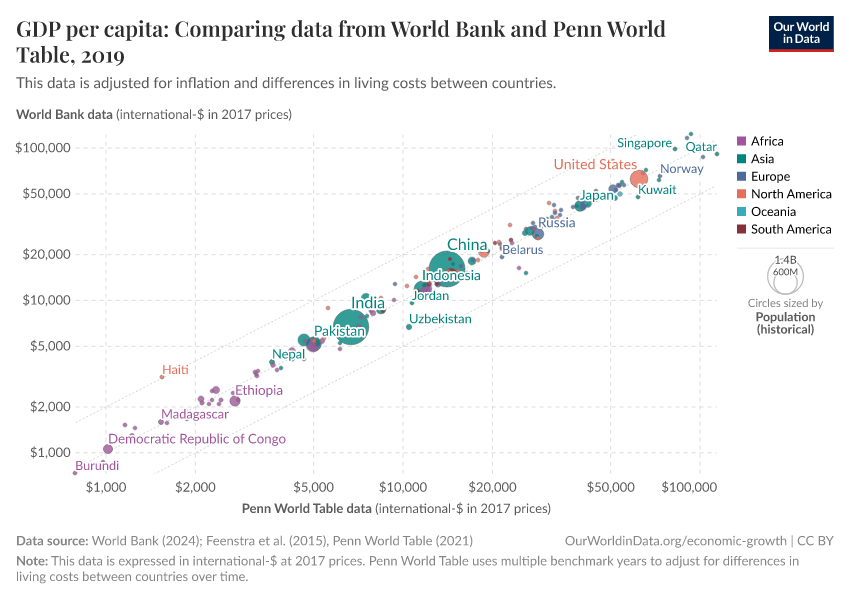
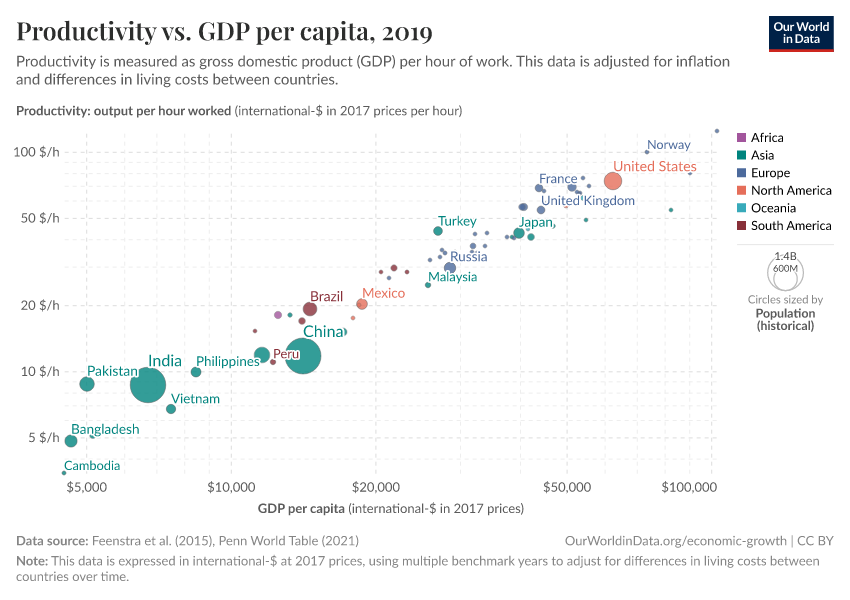
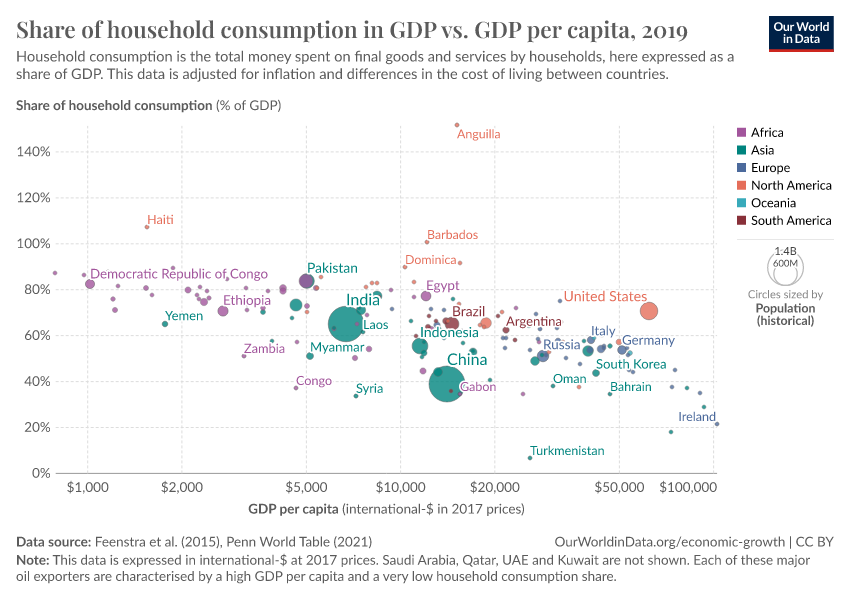
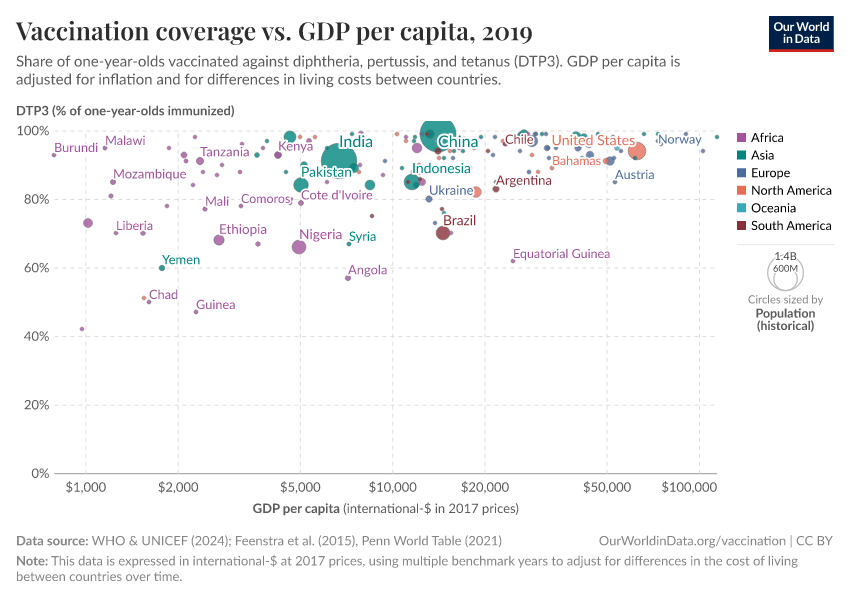
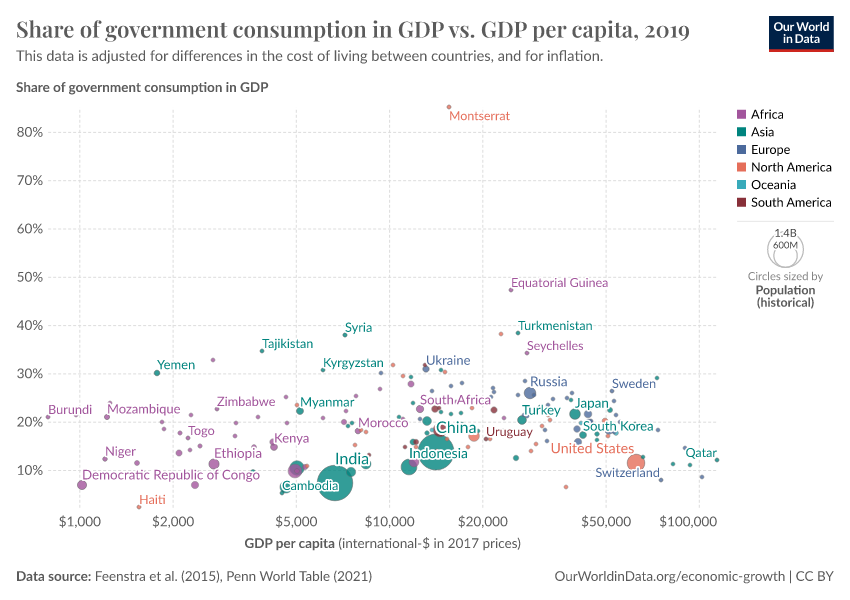


More Data on Economic Growth
Frequently Asked Questions
What are international-$ and why are they used to measure incomes?
Much of the economic data we use to understand the world, such as the incomes people receive or the goods and services firms produce and people buy, is recorded in the local currencies of each country. That means the numbers start out in rupees, US dollars, yuan, and many others, and without adjusting for inflation over time. This is known as being in “current prices” or “nominal” terms.
Sources and processing
This data is based on the following sources
How we process data at Our World in Data
All data and visualizations on Our World in Data rely on data sourced from one or several original data providers. Preparing this original data involves several processing steps. Depending on the data, this can include standardizing country names and world region definitions, converting units, calculating derived indicators such as per capita measures, as well as adding or adapting metadata such as the name or the description given to an indicator.
At the link below you can find a detailed description of the structure of our data pipeline, including links to all the code used to prepare data across Our World in Data.
Notes on our processing step for this indicator
We estimated this indicator as the corresponding value of GDP divided by the population of each country, available in the original dataset.
We excluded values considered outliers in the original dataset (i_outlier = "Outlier"), due to implausible relative prices (PPPs divided by exchange rates).
We replaced GDP values for Bermuda with different estimates (output side, single price benchmark) due to the unusual changes on prices in this country.
Reuse this work
Citations
How to cite this page
To cite this page overall, including any descriptions, FAQs or explanations of the data authored by Our World in Data, please use the following citation:
“Data Page: GDP per capita”, part of the following publication: Max Roser, Bertha Rohenkohl, Pablo Arriagada, Joe Hasell, Hannah Ritchie, and Esteban Ortiz-Ospina (2023) - “Economic Growth”. Data adapted from Feenstra et al.. Retrieved from https://archive.ourworldindata.org/20260518-093348/grapher/gdp-per-capita-penn-world-table.html [online resource] (archived on May 18, 2026).How to cite this data
In-line citationIf you have limited space (e.g. in data visualizations), you can use this abbreviated in-line citation:
Feenstra et al. - Penn World Table (2025) – with major processing by Our World in DataFull citation
Feenstra et al. - Penn World Table (2025) – with major processing by Our World in Data. “GDP per capita – Penn World Table – In constant international-$” [dataset]. Feenstra et al., “Penn World Table 11.0” [original data]. Retrieved June 13, 2026 from https://archive.ourworldindata.org/20260518-093348/grapher/gdp-per-capita-penn-world-table.html (archived on May 18, 2026).Download
Quick download
Download the data shown in this chart as a ZIP file containing a CSV file, metadata in JSON format, and a README. The CSV file can be opened in Excel, Google Sheets, and other data analysis tools.
Data API
Use these URLs to programmatically access this chart's data and configure your requests with the options below. Our documentation provides more information on how to use the API, and you can find a few code examples below.
Data URL (CSV format)
https://pages.owid.io/grapher/gdp-per-capita-penn-world-table.csv?v=1&csvType=full&useColumnShortNames=falseMetadata URL (JSON format)
https://pages.owid.io/grapher/gdp-per-capita-penn-world-table.metadata.json?v=1&csvType=full&useColumnShortNames=falseExcel / Google Sheets
=IMPORTDATA("https://pages.owid.io/grapher/gdp-per-capita-penn-world-table.csv?v=1&csvType=full&useColumnShortNames=false")Python with Pandas
import pandas as pd
import requests

# Fetch the data.
df = pd.read_csv("https://pages.owid.io/grapher/gdp-per-capita-penn-world-table.csv?v=1&csvType=full&useColumnShortNames=false", storage_options = {'User-Agent': 'Our World In Data data fetch/1.0'})

# Fetch the metadata
metadata = requests.get("https://pages.owid.io/grapher/gdp-per-capita-penn-world-table.metadata.json?v=1&csvType=full&useColumnShortNames=false").json()
R
library(jsonlite)

# Fetch the data
df <- read.csv("https://pages.owid.io/grapher/gdp-per-capita-penn-world-table.csv?v=1&csvType=full&useColumnShortNames=false")

# Fetch the metadata
metadata <- fromJSON("https://pages.owid.io/grapher/gdp-per-capita-penn-world-table.metadata.json?v=1&csvType=full&useColumnShortNames=false")
Stata
import delimited "https://pages.owid.io/grapher/gdp-per-capita-penn-world-table.csv?v=1&csvType=full&useColumnShortNames=false", encoding("utf-8") clear